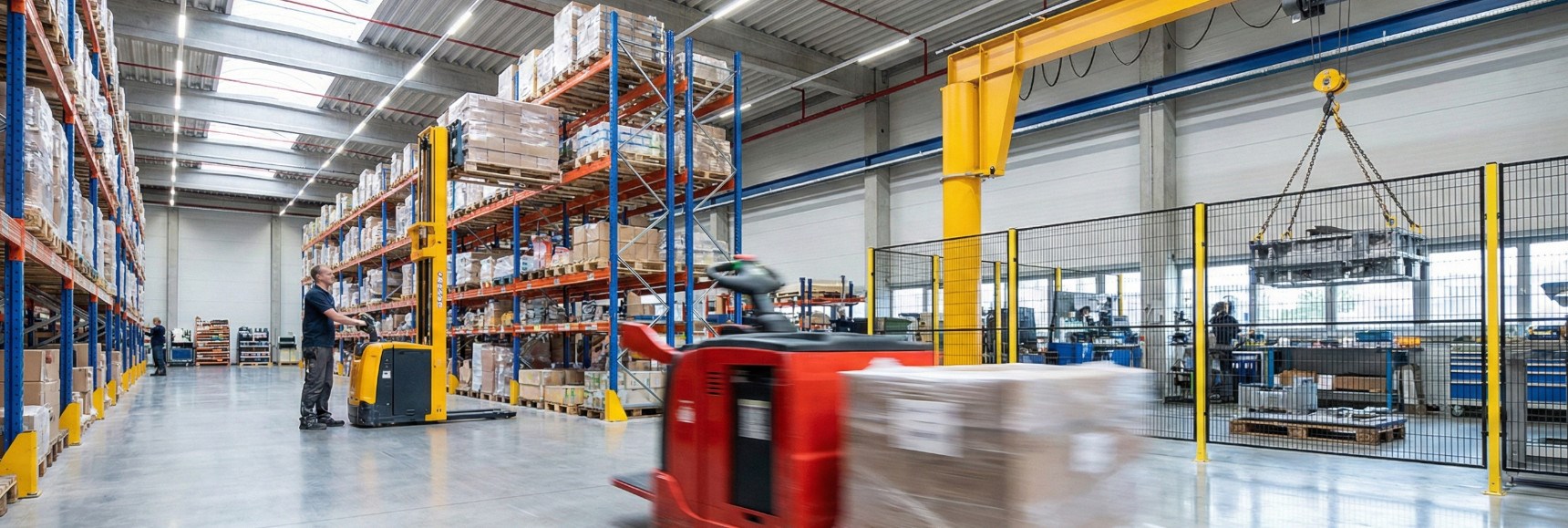
Planning Guide for Transport and Lifting Equipment for Businesses Establishing New Warehouses
The most fundamental element determining operational efficiency during the establishment of a new warehouse is the synchronization of the architectural project with technical equipment capacity and the optimization of all material flow from goods reception to shipment according to logistics engineering principles. While businesses often focus on racking systems, they may ignore the maneuverability and floor load limits of the vehicles that will reach those racks during the planning stage. The correct equipment set manages warehouse traffic. It lowers operating costs. It maximizes personnel productivity.
Defining the physical limits and work volume of the warehouse with precise data before making an equipment investment is the most strategic step to shorten the return on investment (ROI). Even the most advanced vehicles remain inefficient when engineering calculations are done incorrectly.
-
Aisle Width (AST): The net distance required for the selected stacker or forklift to take the pallet and turn must be measured.
-
Shelf Height: The boom height and capacity reduction (de-rating) of the equipment that will place loads on the top rack must be calculated.
-
Floor Structure: The capacity of the epoxy or concrete floor to carry tons of vehicle and load weight must be checked.
-
Ramp Gradient: The angle of the ramp at the warehouse entrance must be compatible with the climbing ability of an electric pallet truck.
-
Daily Pallet Movement: The number of pallets entering and exiting per day determines the choice of battery technology (Lithium-Ion vs. Gel).
In e-commerce warehouses where a high number of product items are managed in limited areas, speed and maneuverability are the cornerstones of the operation. In these types of warehouses, low-tonnage but high-frequency movements are generally observed.
Equipment Set Recommendation:
-
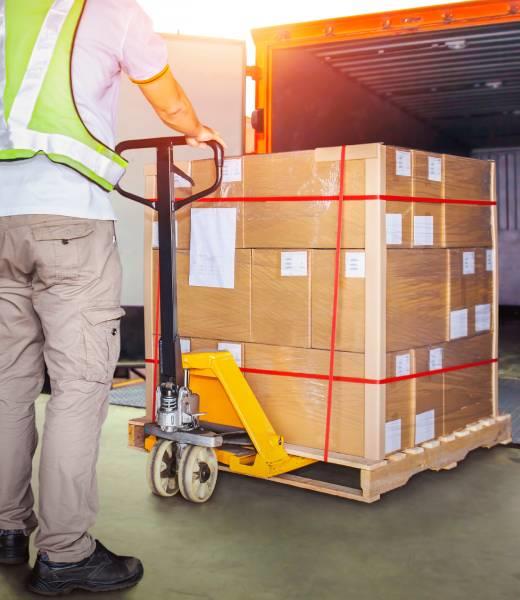
Electric Pallet Truck (Compact Series): Used to quickly unload pallets from trucks or vans in the goods reception area. Narrow chassis models should be preferred.
-
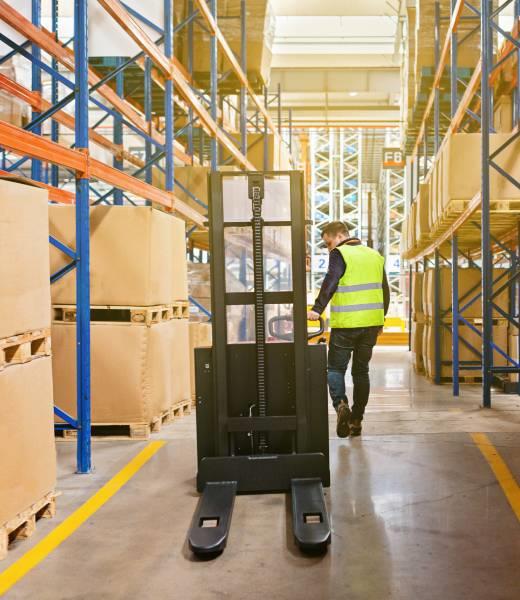
Semi-Electric Stacker: An economical solution for placing products on racks. Movement is manual, lifting is electric.
-
Load Platform: If the warehouse has a mezzanine structure, it is a safe solution for the transfer of packaged cargoes between floors.
Why This Set?
Products in e-commerce operations are usually light but diverse. Manual power use tires personnel quickly. Compact electric solutions speed up the workflow. It prevents loss of space.
In logistics centers with large square meters and high racks, professional vehicles that cover long distances horizontally and reach high altitudes vertically should be used. Durability is the priority here.
Equipment Set Recommendation:
-
Electric Pallet Truck (Ride-on Platform): Models where the operator stands on a platform to transport pallets in long aisles. It can reach speeds of 6-9 km/h.
-
Battery Stacker (Full Electric): Performs safe stacking on racks exceeding 5 meters. It does not shake the pallet thanks to precise proportional valves.
-
Load Platform (Heavy Duty): Acts as an elevator for the shipment of heavy pallets or picking vehicles between floors.
Why This Set?
Time is of the essence in logistics centers. Using an electric pallet truck eliminates manual walking distances. It provides time savings. It is suitable for shift work.
In warehouses where production lines are fed and heavy raw materials are stocked, not only pallets but also the management of irregular and very heavy loads (machine parts, molds) is involved.
Equipment Set Recommendation:
-
Monorail Crane: Ideal for lifting and transporting heavy parts (engines, sheets, molds) on a fixed route over the production line.
-
High-Capacity Stacker: Used to position 2-3 ton raw material pallets vertically. Its high-strength chassis prevents the risk of tipping.
-
Electric Pallet Truck: Transports finished products from production to the shipping area without fatigue.
Why This Set?
Occupational safety is the most critical heading in production facilities. It is impossible to transport heavy parts with human power. Monorail crane systems clear floor traffic by lifting the load. It provides safety.
|
Warehouse Type |
Core Need |
Critical Equipment |
Complementary Solution |
|
E-Commerce |
Tight Space Maneuver |
Compact Stacker |
Manual Pallet Truck |
|
Logistics Center |
High Speed / Altitude |
Electric Pallet Truck |
Load Platform |
|
Production Facility |
Heavy Load / Fixed Line |
Monorail Crane |
Heavy Duty Pallet Truck |
When establishing a new warehouse, equipment should be seen as part of a system, not just as machines. Periodic maintenance and operator training should not be neglected. A correctly planned machine park can increase the capacity of the warehouse by 30%. Paftar is by your side in choosing the most suitable tonnage and technology for your logistics processes. It offers tested solutions for different scenarios. You can get on-site discovery support by contacting our technical team.