Top 12 Most Common Mistakes in Pallet Truck Usage and Correct Practices
Pallet trucks, which are among the most used transport vehicles in warehouse and logistics facilities, can lead to serious occupational accidents and expensive equipment failures due to incorrect operator reflexes, even though they are structurally extremely reliable. It is possible to reduce these risks to zero with quality pallet truck operator training. As well as investing in durable equipment like the Paftar pallet truck product range, it is of vital importance to embed the culture of using these devices correctly in the field. We have compiled the 12 most critical usage mistakes encountered in the field and safe usage methods that will form the basis of your warehouse occupational accident prevention strategy.
- Incorrect Positioning of the Load Center
- Pallet Truck Capacity Exceedance (Overloading)
- Incorrect or Incomplete Pallet Entry
- Wrong Direction and Speed on the Ramp
- Sudden Maneuvers and Sharp Turns
- Usage on Unsuitable and Rough Floors
- Continuing to Work with Damaged Wheels
- Pulling in the Wrong Position Instead of Pushing
- Carrying the Load at Maximum Height
- Blocking the Field of Vision
- Uncontrolled Speed in Narrow Aisles
- Entering Low-Profile Pallets with a Standard Fork
- Safe Operation Starts with the Right Equipment
1. Incorrect Positioning of the Load Center
-
Mistake: Carrying the pallet or load by placing it only on the tip (front part) of the forks.
-
Risk/Result: The disproportionate load on the chassis disrupts the balance, creates a risk of tipping, and can bend the device by applying excessive pressure to the carrier arms of the hydraulic pump.
-
Correct Practice: According to pallet truck safe usage principles, the load must always rest at the very bottom of the forks, that is, up to the point closest to the main chassis (body).
2. Pallet Truck Capacity Exceedance (Overloading)
-
Mistake: Loading above the nominal lifting capacity stated on the label of the machine.
-
Risk/Result: Explosion of the hydraulic system, permanent bending of the forks, shattering of the wheels, and sudden collapse of the load.
-
Correct Practice: Pallet truck capacity exceedance must never be tolerated. The carrying capacity of the equipment must be strictly adhered to, and heavy pallets must be divided into two if necessary.
3. Incorrect or Incomplete Pallet Entry
-
Mistake: Trying to lift the load halfway without fully inserting the forks into the pallet.
-
Risk/Result: Breaking the bottom boards of the wooden pallet, disrupting the balance of the load and tipping it over.
-
Correct Practice: The operator must make a correct pallet entry; the forks must be pushed in completely until they are aligned from the other end or the final point of the pallet.
4. Wrong Direction and Speed on the Ramp
-
Mistake: Keeping the load in front (load facing down) while descending a sloped ramp.
-
Risk/Result: The load sliding off the pallet due to gravity and falling on the operator, or the vehicle going out of control.
-
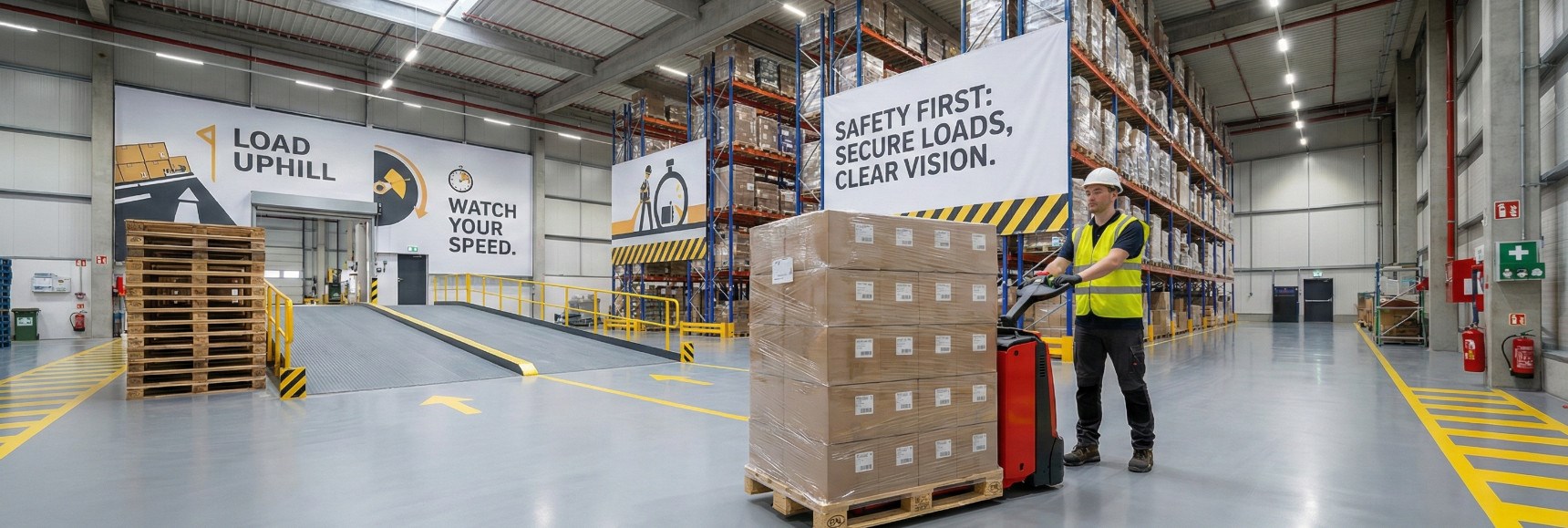
Correct Practice: Pallet truck ramp usage rules are very clear; the load must always face uphill when going up and down a ramp. The operator must keep the load behind them while going down the ramp and steer the vehicle slowly.
5. Sudden Maneuvers and Sharp Turns
-
Mistake: Suddenly turning the steering wheel while moving at full speed, especially in battery-powered models.
-
Risk/Result: Skidding of heavy pallets due to centrifugal force, product damage, and tipping of the vehicle.
-
Correct Practice: Speed should be reduced to a minimum when approaching turning points, and maneuvers should be made with wide and smooth angles.
6. Usage on Unsuitable and Rough Floors
-
Mistake: Proceeding without slowing down on floors with deep cracks, wet surfaces, or covered with industrial waste.
-
Risk/Result: Tipping of the load as the wheels get stuck in a pothole, the operator slipping and falling.
-
Correct Practice: The driving route must always be kept clean, and the speed must drop below pedestrian speed when passing through areas with floor irregularities.
7. Continuing to Work with Damaged Wheels
-
Mistake: Continuing to work with wheels whose polyurethane surface is shattered, bearing is locked, or tangled with rope/stretch film.
-
Risk/Result: The operator exerting extraordinary physical effort as surface friction increases, scratching the floor, and burning out the drive motor in motorized models.
-
Correct Practice: Wheels must be cleaned regularly, and broken or worn wheels must be replaced with new ones without wasting time.
8. Pulling in the Wrong Position Instead of Pushing
-
Mistake: In manual models, moving forward by constantly pushing a heavy load at a non-ergonomic angle that puts pressure on the spine.
-
Risk/Result: Herniated discs, muscle strains, and long-term occupational disabilities.
-
Correct Practice: When using a manual device on flat floors, it is ergonomically much safer for the operator to pull the vehicle at an appropriate angle (using body weight). (Except for ramps).
9. Carrying the Load at Maximum Height
-
Mistake: Pumping the forks to the highest level allowed by the hydraulics and moving in the aisle that way.
-
Risk/Result: Tipping of the pallet at the slightest floor unevenness due to the center of gravity being moved upwards.
-
Correct Practice: During transfer, the load should be lifted into the air just enough to cut contact with the ground (approximately 3-5 cm) and carried that way.
10. Blocking the Field of Vision
-
Mistake: Trying to carry massive loads alone that exceed the operator's height and completely block their view ahead.
-
Risk/Result: Crashing into other workers emerging from blind spots or into racks.
-
Correct Practice: If the field of vision is blocked, the device should be used backward (by pulling) or support should be obtained from a second staff member (spotter) to guide.
11. Uncontrolled Speed in Narrow Aisles
-
Mistake: Entering between racks at high revs with motorized devices.
-
Risk/Result: Rack collapse as a result of hitting the rack legs or the operator getting stuck between the device and the rack.
-
Correct Practice: Millimetric maneuvers must be made safely by activating the "turtle mode" (slow drive) found in the ET15E electric pallet truck model, especially in busy and narrow warehouses.
12. Entering Low-Profile Pallets with a Standard Fork
-
Mistake: Forcing entry into pallets with low bottom clearance due to export or custom production with standard size (85 mm) devices.
-
Risk/Result: Breaking the pallet boards, separating the load from the pallet.
-
Correct Practice: If special pallets are used in your facility, specific models with a 51 mm fork entry height, such as the TP20L low chassis pallet truck, should be used without forcing.
13. Safe Operation Starts with the Right Equipment
Minimizing operator errors is possible not only through continuous training but also through engineering solutions that adapt to your working conditions. You can review the industrial advantages in our article on locally made pallet trucks: why they're the smarter pick to choose the most suitable equipment for your facility. In addition, you should definitely check out the occupational safety in pallet truck usage: frequently asked questions guide we prepared to develop the safety culture in your enterprise and distribute to your personnel. Safe equipment and conscious use are the unshakable foundation of a profitable warehouse.