Safe Transport with Load Platforms, Machine Skates, and Beam Trolleys: How to Reduce Big Risks with Small Equipment?
Moving machines or molds weighing tons in industrial facilities and workshops is a process riskier than lifting them. In areas where cranes cannot reach or ceiling height is insufficient, moving the load on the ground is mandatory. At this point, compact equipment such as machine skates, load platforms, and beam trolleys come into play.
Despite their small size, these tools carry loads of up to 20-30 tons. However, wrong usage leads to major work accidents. We examined technical limits and correct usage scenarios to ensure safety while increasing operational efficiency.
Let's define these three pieces of equipment technically to prevent concept confusion:
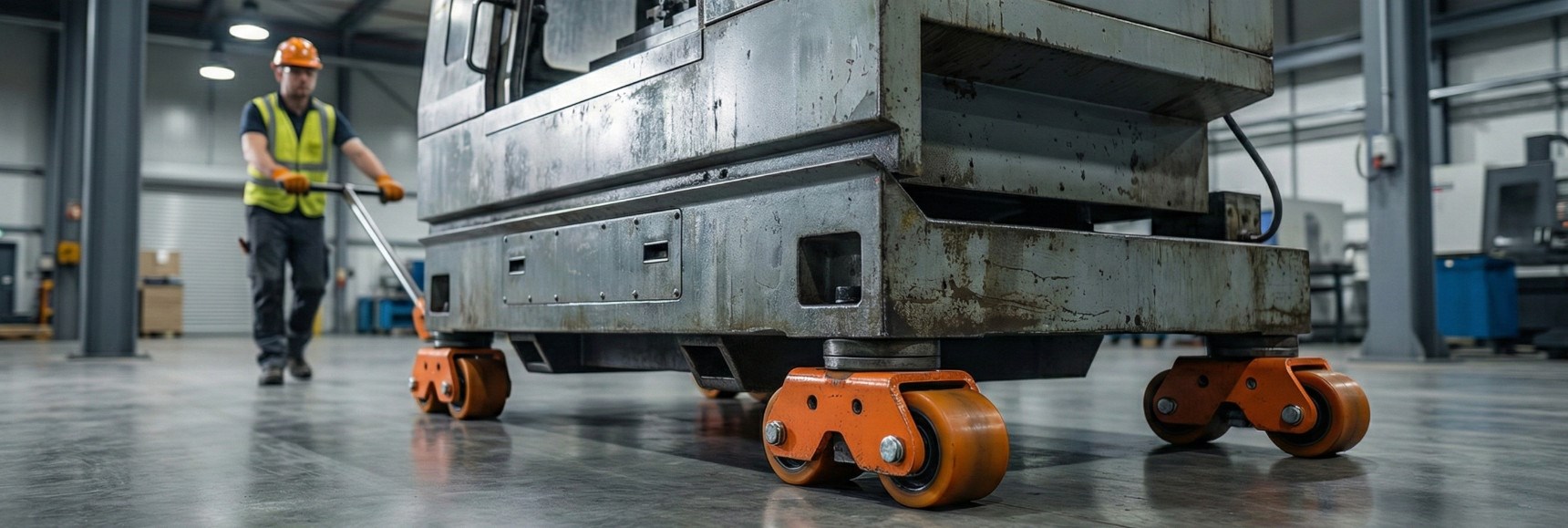
- Machine Skates (Domuz Arabası): Low-profile carriers with steel or polyurethane wheels, generally used to move heavy industrial machinery (lathe, press, CNC, etc.) over short distances. The front group usually has a rotating turntable and provides steering.
- Load Platform: Wheeled plates with a wide base that transfer loads within the factory. They offer a larger surface area compared to machine skates.
- Beam Trolley (Şaryo): Unlike the others, it works in the air, not on the ground. It hangs on I-profile (NPI) beams and allows the load to move left and right on the horizontal plane with a chain block attached to it.
These tools are generally used in factory relocations, machine installations, or production line revisions.
- Machine Moving: When a CNC machine needs relocation, it is lifted with a jack. Machine skate sets are placed in a balanced manner at the front and rear points underneath. Thus, tons of weight can be pushed by human power or a towing vehicle.
- Rail Transport: The beam trolley mounted on the I-profile beam on the warehouse ceiling takes the load from one point and transports it to another through the air. Ideal for not obstructing ground traffic in narrow aisles.
- Heavy Part Transfer: A heavy engine block coming off the production line is fixed onto a load platform and taken to the assembly line.
Safe transport starts with using the right capacity on the right ground.
1. Selection of Machine Skates and Load Platforms
- Carrying Capacity: Generally starts from 2 tons and goes up to 24 tons when used as a set. The total weight of the load is not calculated by dividing it by the number of skates used; a safety factor (1.25) must be added.
- Ground Condition: These equipment have small wheel diameters. Therefore, the floor must be smooth concrete or epoxy. Wheels get stuck and the load tips over on floors with cracks, pits, or grates.
- Wheel Type: Select polyurethane models for sensitive floors, and steel-wheeled models for rough floors and extremely heavy loads.
2. Beam Trolley (Manual and Geared) Selection
- Profile Compatibility: Not every beam trolley fits every profile. The trolley wheel spacing must be adjusted according to the width of the I-beam.
- Capacity: Ranges between 500 kg and 10 tons. The carrying capacity of the beam it hangs on is as important as the trolley capacity.
Risk tolerance is zero in heavy load moving operations. Here are 3 basic rules to consider when using machine skates, load platforms, and beam trolleys:
1. Center of Gravity and Balance (Tipping Risk)
The center of gravity of the load must fall exactly in the middle of the triangular or rectangular area formed by the carrying equipment. When placing machine skates, the heaviest point of the machine is taken as a reference. Avoid sudden stops and starts while the load is in motion; inertia can tip the load over.
2. Steering and Crushing Risk
Never intervene manually while the machine is moving. Steering handles (drawbars) must be used. Do not stand between the load platform and the wall. The operator must always stand in the escape direction against the possibility of the load tipping over.
3. Connection and Fixing
Ensure that studs and nuts are fully tightened in beam trolley assembly. The chain block hook must sit in the exact center of the trolley. Side pulling (angled lifting) is prohibited; this action derails the trolley.
Small equipment is the key point of large operations. A correctly selected beam trolley saves the cost of an overhead crane; a high-quality machine skate set completes the placement of massive machines in minutes. Paftar ensures maximum mobility without compromising work safety in your business with its certified load-carrying solutions. Do not risk your load, use equipment suitable for technical limits.