Manlift Selection Guide: Working Height, Floor, Wind, and Indoor/Outdoor Criteria
Working at heights in construction, facility maintenance, warehouse management, or assembly operations is a critical process that requires zero fault tolerance. Choosing the wrong aerial work platform (manlift) not only prolongs the operation time and increases costs but also directly invites fatal occupational accidents such as tipping, crushing, or falling. A comprehensive manlift selection guide ensures you create your technical specifications correctly when renting or buying the machine you need. Before examining the solutions in the Paftar manlift product range to increase your operational efficiency and guarantee the safety of your personnel, you need to clarify the following technical criteria for your site.
1. 1. Distinction Between Platform Height and Working Height
The most common mistake made when choosing a manlift is confusing "platform height" with "working height."
-
Platform Height: It is the maximum distance the machine's basket (the floor the personnel stands on) reaches from the ground.
-
Manlift Working Height: It is found by adding an average distance of 2 meters, which personnel can safely reach, to the platform height. (E.g., The working height of a machine with a platform height of 10 meters is 12 meters.)
When placing an order or preparing a specification, you must always base it on the final point the personnel will intervene with, namely the working height.
2. 2. Engine Selection Based on Indoor and Outdoor Conditions
-
Whether the working area is indoors or outdoors directly determines the machine's energy source and tire type.
-
Indoor Manlift Selection: Battery-powered (electric) models that operate silently with absolutely zero emissions must be preferred inside closed warehouses, factories, or malls. Additionally, "non-marking white tire" equipment is essential so that it does not scratch the floor covering (epoxy, ceramic, etc.) and does not leave black marks.
-
Outdoor Manlift Selection: In harsh terrain conditions, muddy or uneven construction sites, models with diesel engines, 4x4 traction power, and foam-filled rough terrain tires should be used.
3. 3. Floor Incline and Carrying Capacity (Load Limits)
How many personnel will work in the basket and how much weight in tools/materials they will carry with them determine the capacity. Overloading is the number one cause of tipping. Also, the floor incline (gradeability) must be taken into account. Is the ground where the machine will work perfectly flat concrete, or a construction site ramp with a 20% incline? Devices with outriggers or hydraulic leveling systems should be used on sloped terrains.
4. 4. Manlift Wind Limit and Weather Conditions
In working at height operations outdoors, wind is a massive lateral force that disrupts the machine's balance. According to international standards (EN 280), the maximum safe manlift wind limit of a platform to be used outdoors is generally 12.5 meters per second (approx. 45 km/h). When the wind exceeds this speed, the operation must be stopped immediately and the basket lowered. For detailed information on the field applications of these rules, you can review our guide to safe working at heights with manlift article.
5. Machine Types and Selection Strategies by Scenario
Is the access you need only "straight up," or do you also need to reach "horizontally" over an obstacle? This question determines the platform type.
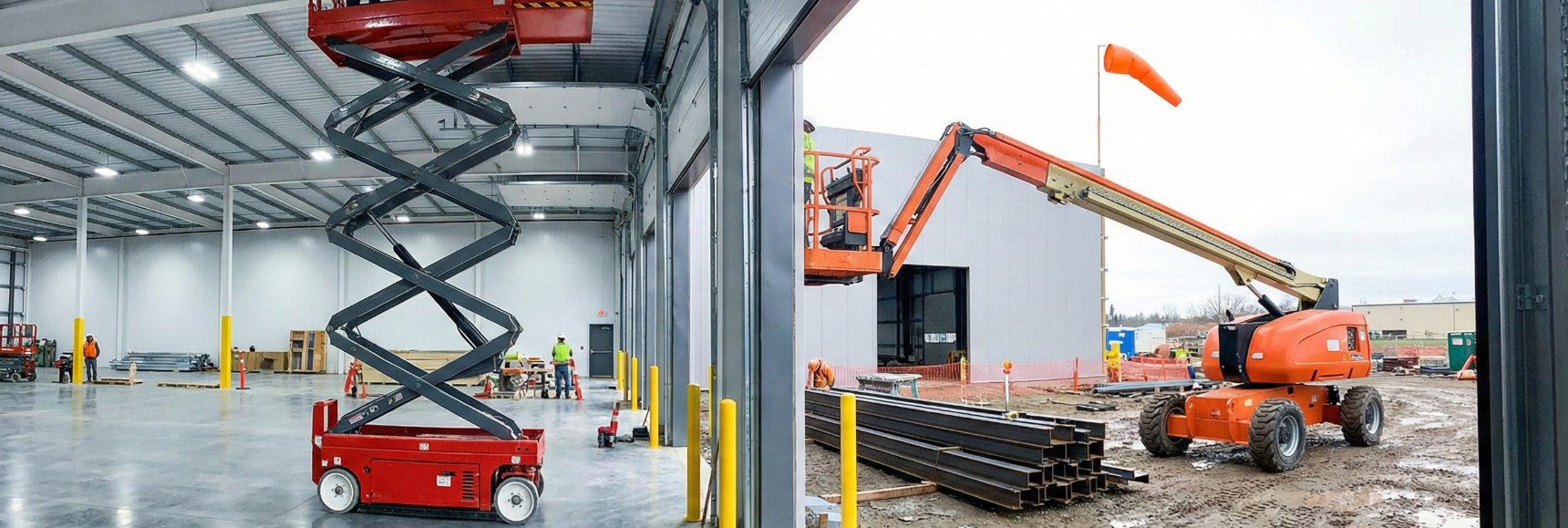
Scissor Lift Selection (Vertical Access and Large Area)
These are machines that can only move on a flat and vertical (up-down) axis, have a wide basket area, and high load-carrying capacity.
-
Usage Scenario: Situations where you can directly get under the job, such as ceiling lighting installation, warehouse rack counts, facade painting, or ventilation duct installation.
-
Example Solution: For operations where you need a 12-meter working height indoors and a high carrying capacity like 320 kg, the Paftar SL12 manlift (12.2 metres, 320 kg) model offers an ideal working area with its wide basket.
Articulated Boom Lift Selection (Obstacle Access and Flexibility)
These are systems whose boom structure can fold in a "Z" shape, allowing reaching the target by jumping over points that cannot be reached with the body of the machine (production line, machinery, or landscaping areas).
-
Usage Scenario: Intervening with a pipe on the ceiling by reaching over the production line inside a factory or reaching the building facade by passing through the branches of a tree. It is the series with the highest maneuverability.
Telescopic Boom Lift Selection (Maximum Horizontal Reach)
Working with a telescope (interlocking straight pipes) logic, these are predominantly diesel machines that can reach the highest points and the furthest horizontal distances.
-
Usage Scenario: Ship hull maintenance in shipyards, building facade panel installation on massive construction sites, or wide landscaping areas where the machine cannot get close to the building.
6. Summary Comparison Table
|
Feature / Platform Type |
Scissor Lift |
Articulated Boom Lift |
Telescopic Boom Lift |
|
Access Direction |
Vertical Only (Up/Down) |
Vertical and Horizontal (Over Obstacles) |
Maximum Horizontal and Vertical Reach |
|
Load/Personnel Capacity |
Very High (Wide Basket) |
Medium |
Medium / Low |
|
Maneuver / Turning Radius |
Maneuvering in narrow spaces (Good) |
Navigating around obstacles |
Requires wide space |
|
Ideal Scenario |
Jobs that can be accessed directly underneath |
Jobs requiring reaching over machines/installations |
Jobs requiring horizontal access from far away |
Once you have determined the right machine, managing the budget and timeline of your project and organizing details such as transportation and operator certification are also of great