Why Does Battery Selection Directly Affect Machine Performance?
Many businesses investing in industrial equipment make the mistake of evaluating the performance of electric handling and lifting vehicles solely by their motor power. However, no matter how powerful a machine's motor is, the only element that determines the potential of that motor is its energy source. The battery is not just the "fuel tank" of your machine; it is also its heart.
A battery chosen below its capacity or in the wrong technology causes even the latest model machine to run at half capacity, fail to climb ramps, or run out of energy in the middle of a shift. So, exactly how and why does battery selection directly affect the real performance of your machine in the field?
1. Volts and Amps: The Mathematical Equivalent of Speed and Durability
The values on the batteries are not just technical details; they are absolute indicators of how "fast" and "durable" your machine will be in the field.
- Volts (V) are the Muscle Power of the Machine: The voltage value determines how much torque (power) the machine's hydraulic pump and drive motor will produce. Using a low-voltage battery for a heavy-duty and heavily used battery-powered stacker causes the walking speed of the machine to drop dramatically when loaded and the lifting mast to become sluggish.
- Ampere-Hours (Ah) are the Breath of the Machine: The ampere value shows how long the machine can continuously produce that power. A battery chosen with a low capacity (Ah) causes the machine to need charging before the shift ends, bringing the operation to a halt.
2. Technology Difference: Uninterrupted Performance vs. the Need to Rest
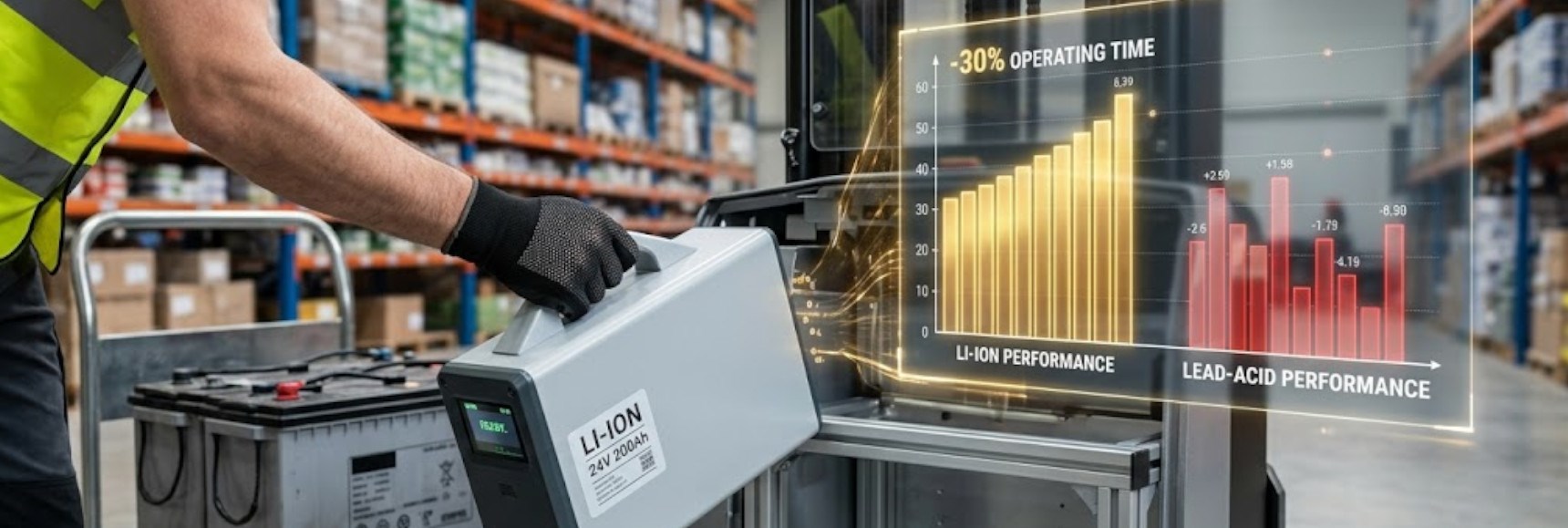
The chemical structure of the battery (Lead-Acid, Gel, or Lithium-Ion) directly dictates the daily work pace of the machine.
For a warehouse operating on a single shift (8 hours) a day, a standard lead-acid battery can provide sufficient performance. However, using a lead-acid battery in an e-commerce or logistics center operating continuously for 3 shifts (24 hours) causes the machine to "lay idle" for a third of the day due to charging and cooling times (8-12 hours on average). Batteries with lithium-ion technology, on the other hand, allow the machine to remain active 24 hours a day with 100% performance without experiencing a voltage drop through "opportunity charging" done during breaks.
3. The Invisible Cost of the Wrong Choice: Electronic Wear
Performance does not just mean speed and power; it also means stability. When a battery with a lower capacity than the machine needs or a worn-out battery is used, a "Voltage Drop" occurs.
When the machine is lifting a heavy pallet and sufficient energy does not reach the motor, the system draws more current (amps) to compensate. This situation causes:
- Overheating of the motor,
- Burning of the electronic control cards (brain),
- Melting in the wiring, and thousands of dollars in severe damage in the long run.
4. The Secret to Maintaining Performance: Compatible Charging and Maintenance Routine
Even if you buy the best battery in the world that is most compatible with your machine, performance loss is inevitable if it is not charged correctly. Using the wrong rectifier (charger) or lack of maintenance increases the internal resistance of the battery, slowing down energy transmission. This prolongs the machine's reaction times and makes it clumsy.
To ensure performance remains as it was on the first day and to protect the battery cells, your operations team must strictly apply the critical steps in the spare parts and battery life: proper charging, storage, and maintenance guide.
In summary; if you want to get 100% efficiency from your stacker, you should see battery selection not as a detail to be left for later, but as the main factor determining the machine's performance. Choosing the battery most suitable for your load profile, number of shifts, and working environment will directly increase your operational speed.