10 Technical Criteria to Consider When Buying an Electric Stacker
The operational efficiency of motorized lifting equipment, preferred to maximize vertical space utilization in industrial storage facilities and to ensure the safe placement of heavy palletized loads on rack systems, depends on the correct analysis of specific engineering parameters perfectly adapting to the daily logistics cycle and architectural constraints of the enterprise. It speeds up logistics processes. It lowers the risk of occupational accidents. Electric stacker selection affects operating costs directly. A field analysis is essential before investment. You can examine Paftar stacker models to determine the equipment suitable for your needs.
- 1. Stacker Lifting Height and Derating Factor
- 2. Load Center and Stacker Capacity Selection
- 3. Stacker Mast Type: Simplex, Duplex, and Triplex
- 4. Stacker Battery Capacity and Charging Technology
- 5. Operator Ergonomics and Drive Type
- 6. Chassis Strength and Material Quality
- 7. Wheel Type and Floor Compatibility
- 8. Aisle Width (AST) and Maneuverability
- 9. Safety Equipment and Brake Systems
- 10. Service Network, Spare Parts, and Price-Performance Ratio
- Frequently Asked Questions (FAQ)
1. 1. Stacker Lifting Height and Derating Factor
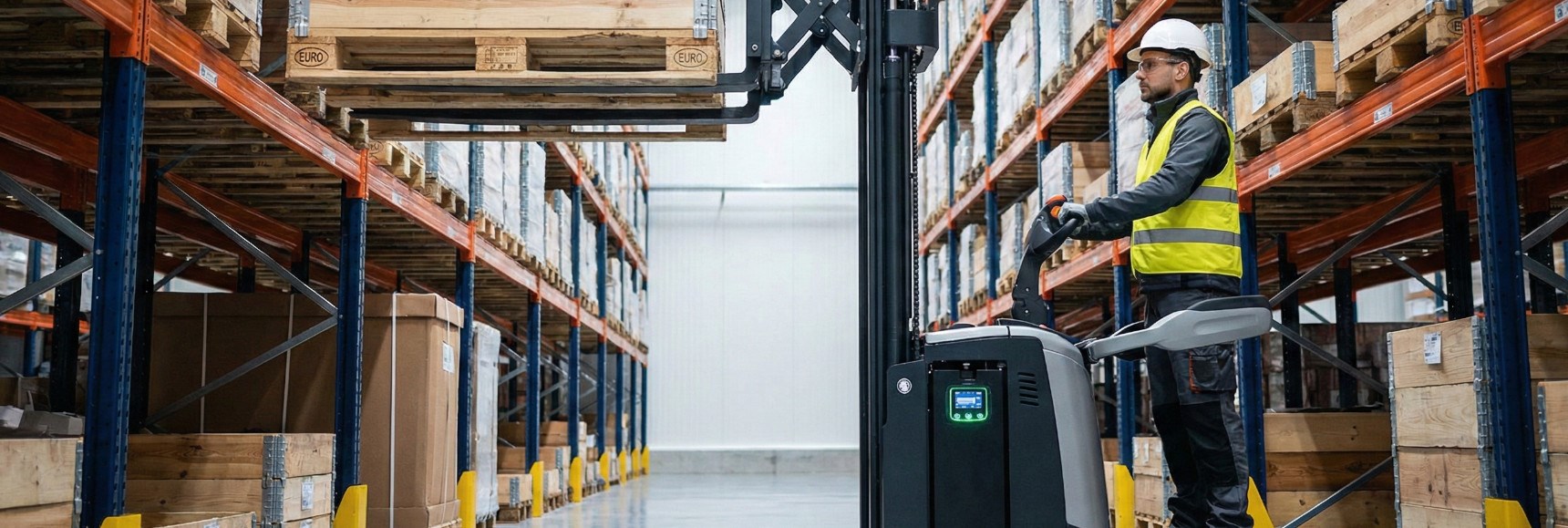
The derating relationship, expressing the maximum vertical point the mast mechanism can reach and the net load amount that can be safely carried at this point, is the most critical mechanical calculation determining the operational safety of enterprises at the highest rack level and forming the basis of the equipment investment. Carrying capacity decreases as height increases. The stacker lifting height must be suitable for the warehouse ceiling. The maximum rack height must be measured beforehand. The load diagram on the device must be examined carefully.
2. 2. Load Center and Stacker Capacity Selection
The load center value, defining the distance of the center of gravity of the load placed on the forks to the machine chassis, is based on 600 mm for standard pallets, while it is a dynamic variable forcing the recalculation of the nominal capacity by changing the balance moment in the case of transporting long or wide materials. Incorrect calculation leads to tipping. Stacker capacity selection is made according to the daily routine. The Paftar MS1516 manual stacker offers an economical start for your light tonnage jobs. You can read our article on manual vs battery stacker comparison for low volume warehouses to decide which system to invest in.
3. 3. Stacker Mast Type: Simplex, Duplex, and Triplex
The mast design, determining the telescoping architecture of the lift columns for facilities with restricted door passage heights or working in low-ceiling areas such as under mezzanines, is a structural engineering solution making it possible to complete the vertical stacking operation without problems by overcoming spatial obstacles when integrated with the free lift feature. The correct stacker mast type prevents getting stuck at door thresholds. The single (simplex) mast is for low racks. The double (duplex) mast targets standard warehouses. The triple (triplex) mast reaches the highest altitudes.
4. 4. Stacker Battery Capacity and Charging Technology
The chemical structure and ampere-hour (Ah) values of energy storage units, determining the uninterrupted working time of motorized systems, are the most important electrical parameters shaping the total cost of ownership (TCO) of the enterprise by directly affecting charging times and spare battery costs in multi-shift intensive logistics centers. Lithium batteries provide fast charging. Gel batteries offer an economical solution. Stacker battery capacity is determined by the number of shifts. You can browse our battery selection and maintenance guide for battery pallet trucks and stackers content to extend battery life.
5. 5. Operator Ergonomics and Drive Type
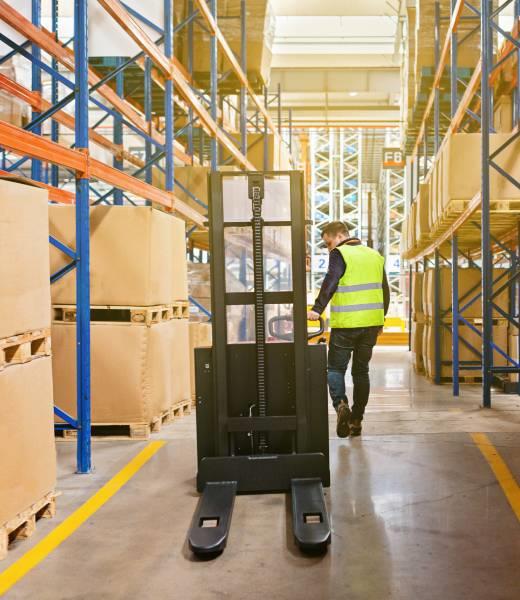
Pedestrian-controlled or foldable ride-on platform vehicle configurations, aiming to minimize the physical fatigue of personnel depending on the length of the transport distance and the intensity of daily working hours, are ergonomic improvements carrying maneuverability to the top level with electromechanical power steering (EPS) systems while increasing operation speed. Pedestrian-controlled models fit tight spaces. Platform models save time over long distances. If you seek narrow aisle performance, the Paftar ES1516E electric stacker provides practical use. Personnel comfort increases work efficiency.
6. 6. Chassis Strength and Material Quality
The high-strength steel chassis construction, preventing flexing under dynamic loads and safely carrying the high pressure produced by the hydraulic system, is the basic building block guaranteeing long years of failure-free service by protecting the mechanical integrity of the equipment under heavy industry conditions. Thin sheet metal chassis deform quickly. Quality steel profiles increase safety. Shock-absorbing bumpers protect the body. The equipment offers long-lasting use.
7. 7. Wheel Type and Floor Compatibility
Polyurethane, nylon, or rubber-based wheel polymers, determining the rolling resistance, shock absorption, and traction performance of the equipment on the ground, are a critical contact point zeroing energy losses caused by friction and maximizing wheel wear life when selected according to the epoxy, concrete, or asphalt floor coating characteristics of the facility. Polyurethane wheels are for epoxy floors. They do not leave marks on the floor. Nylon wheels advance comfortably on concrete floors. The correct wheel does not tire the motor.
8. 8. Aisle Width (AST) and Maneuverability
The net workspace (AST value) required for the selected machine to stack by making a full turn in the aisle between warehouse racks together with a standard Euro pallet on the fork tip is a geometric boundary condition directly determining the rack layout plan in the warehouse architecture. The aisle must be measured when buying a stacker for the warehouse. Narrow chassis models enter narrow aisles easily. The turning radius is checked from the technical sheet. Warehouse space is used efficiently.
9. 9. Safety Equipment and Brake Systems
Electromagnetic brakes, belly button anti-collision switches, and mast drop valves, electronically detecting possible operator errors or risks arising from floor inclination and intervening in the system, are technological shields isolating the logistics area against accidents by meeting international occupational safety norms. The emergency stop button cuts power instantly. The speed limiter ensures safety in corners. The brake system secures the vehicle on the ramp. Personnel always stay safe.
10. 10. Service Network, Spare Parts, and Price-Performance Ratio
Beyond the initial purchase price constituting the financial dimension of the investment decision, the quality of periodic maintenance services the equipment will need throughout its economic life, spare parts availability, and technical service intervention speed create the most valuable after-sales service package preventing production losses of the enterprise. A cheap machine costs a lot when it breaks down. TCO (Total Cost of Ownership) must definitely be calculated. You can examine our factors determining electric stacker prices article to understand how hardware differences alter the budget. After completing the stacker purchasing guide criteria, you can reach our experts from the Paftar contact page to get technical consultancy.
11. Frequently Asked Questions (FAQ)
1. Can a battery stacker be used in areas with ramps? It is possible to work safely in areas with ramps provided that you stay within the gradeability limits specified in the technical specifications of the machine and have an electromagnetic brake system. Manual machines must absolutely not be used on ramps.
2. What exactly does the free lift feature do? It is a system allowing the forks to lift independently up to a certain height before the outer towers (mast) of the elevator start moving upwards. It prevents the mast from hitting the ceiling while stacking loads in areas with low ceiling heights or door passages.
3. Should I choose a lithium battery or a gel battery stacker for my business? Lithium batteries should be preferred if a multi-shift system is applied in your warehouse and you need to put the vehicle on short-term charge (opportunity charging) during the day. Gel battery models are a budget-friendly alternative in operations with a single shift and less daily usage time.