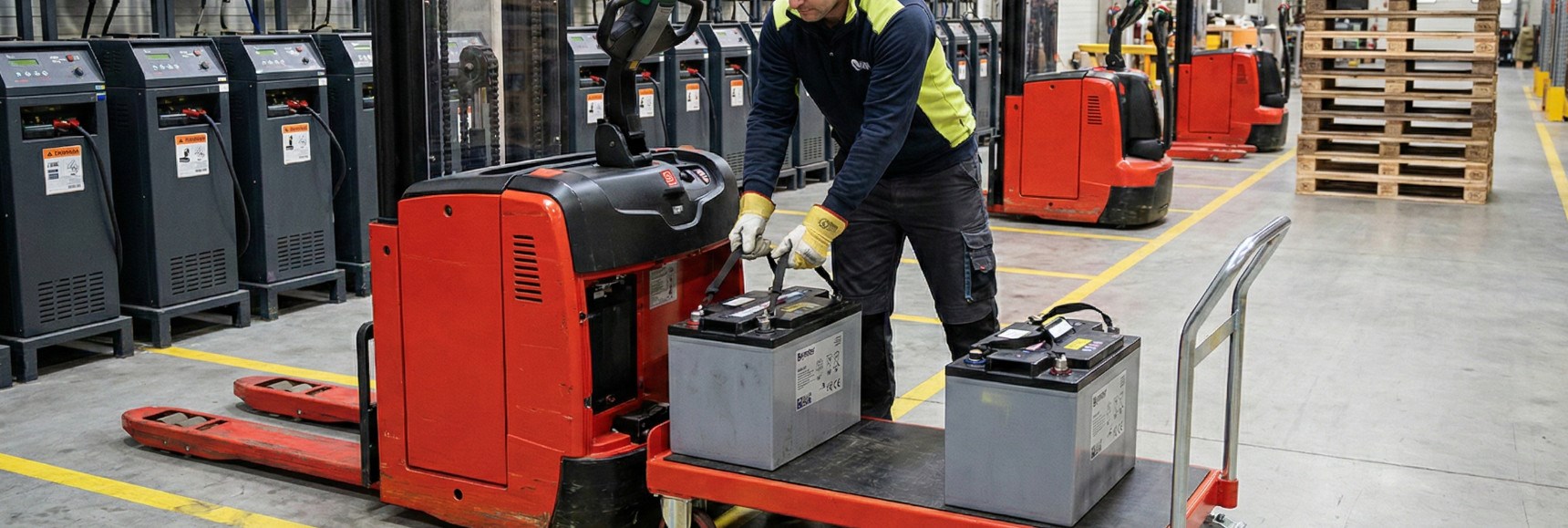
Spare Parts and Battery Life: Proper Charging, Storage, and Maintenance Routine for Battery-Powered Equipment
The most critical component determining the total cost of ownership (TCO) of electric lifting and handling equipment used in logistics operations is undoubtedly the energy storage units. The profitability of a battery-powered pallet truck or a battery-powered stacker investment directly depends on how healthily the battery on it is managed. Incorrect charging habits and neglected periodic maintenance rapidly age the battery cells, leading to premature and expensive spare part costs. So, how is battery life extended in a busy warehouse environment? In this guide, we will examine the scientific maintenance routines that reduce the risk of failure to zero and keep the uptime stable.
1. 5 Basic Factors Determining Battery Life
The chemical structure of batteries is highly sensitive to external factors and usage habits. To understand stacker battery maintenance processes, it is necessary to first know these factors:
-
Charge Cycle (Cycle Life): Every battery has a factory-determined charge/discharge lifespan (e.g., 1500 cycles). Frequently plugging the battery into the charger unnecessarily (except for lithium batteries) consumes this cycle rapidly.
-
Deep Discharge: Allowing the battery capacity to drop below 20% causes sulfation in lead-acid and gel batteries, permanently killing the cells.
-
Operating and Charging Temperature: Batteries do not like excessive heat. Temperatures exceeding 45°C during the charging process or under the sun increase internal resistance and can cut battery life in half.
-
Charger (Rectifier) Compatibility: Old-style chargers that are not compatible with the voltage and amperage values of the battery, are uncalibrated, or are not "smart" will overcharge and swell the battery.
-
Idle Time: Leaving a discharged battery waiting for days without charging leads to an irreversible loss of capacity.
2. Battery-Powered Equipment Charging Rules: Do's and Don'ts
A clear list of battery-powered equipment charging rules that you can hang at your warehouse's charging station to minimize user errors saves lives.
Correct Practices (Do's)
-
Follow the 20% Rule: Plug the equipment into the charger immediately when the battery level reaches 20% (or the red warning zone).
-
Complete the Charge: If the charging process has started, never pull the plug before reaching 100% fullness and the charger gives a "Completed" warning (for Gel and lead-acid batteries).
-
Provide Ventilation: Keep the ventilation of the charging area open to disperse the heat and (in flooded batteries) gas released during charging.
-
Use Original Equipment: Always use the battery and charger combinations recommended by the manufacturer.
Incorrect Practices (Don'ts)
-
Do Not Opportunity Charge (Except Lithium): Do not plug lead-acid or gel battery machines into the charger during the lunch break with the logic of "let it fill up for 15 minutes." This wastes the charge cycle.
-
Do Not Completely Drain the Battery: Do not continue to use the device until the machine becomes unable to move (deep discharge).
-
Do Not Charge a Hot Battery: Do not immediately connect a battery that has just come out of a tough shift and is overheated to the charger; give it some time to cool down.
To fully understand the differences between battery technologies and make the right choice for your business, be sure to check out our battery selection and maintenance guide for battery pallet trucks and stackers article.
3. Daily and Weekly Maintenance Routine
Forklift and stacker battery maintenance processes should be applied in every shift, not after a malfunction occurs.
-
Daily Routine: At the end of the shift, the battery indicator should be checked, and the sockets and cables should be visually inspected for physical crushing or heating. When plugging the device into the charger, ensure the plug is fully seated.
-
Weekly Routine: Battery terminals should be visually inspected against oxidation, and the dust and dirt accumulated on them should be cleaned with a dry cloth. If a flooded lead-acid battery is used, pure water levels should be checked weekly, and water should be added only after charging.
4. Signs of Battery Performance Decline (Early Warning System)
Correctly reading the early warning signals indicating that a battery is nearing the end of its life prevents your workflow from stopping suddenly. These battery performance decline symptoms are:
|
Symptom |
Possible Cause |
Action to be Taken |
|
Running out of charge very quickly |
Cell deaths, sulfation |
A capacity test (discharge test) should be performed. |
|
Prolongation of charging time |
Increased internal resistance, charger failure |
Rectifier output voltage should be measured. |
|
Overheating during charging |
Short circuit, lack of water (in flooded type) |
Charging must be stopped immediately; service must be called. |
|
Physical swelling or odor |
Overcharge, gas compression |
Explosion risk! The battery must be completely withdrawn from use. |
5. Long-Term Battery Storage Conditions
If you will not be using your equipment for more than 1 month due to seasonal fluctuations or factory revisions, battery storage conditions are of vital importance. Batteries must never be stored completely empty (discharged). Before storage, the battery must be 100% fully charged, and its connection to the system must be cut off by turning off the emergency stop button of the device (or unplugging the main socket). The storage area must be dry, not receive direct sunlight, and be at room temperature (15°C - 25°C). Since lead-acid and gel batteries will self-discharge even if not used, they must be connected to a refresh charge every 3-4 weeks.
You can contact our expert support team to analyze the current health status of the batteries in your enterprise or to order new-generation spare parts.