Why Balance and Stability are Critical in Stackers?
In warehouse operations, there is a question just as important as how many tons a piece of equipment can lift: How stable can it keep that load when it is at height? In stackers, balance and stability are not just "safety features"—they are the physical boundaries that determine the continuity of your operations.
When you lift tons of weight several meters into the air, the machine's center of gravity shifts. At this point, even the slightest imbalance can lead to the equipment tipping over, damage to the load, and most importantly, personnel injuries. So, what are the elements that determine this stability?
1. The Load Center and the Stability Triangle
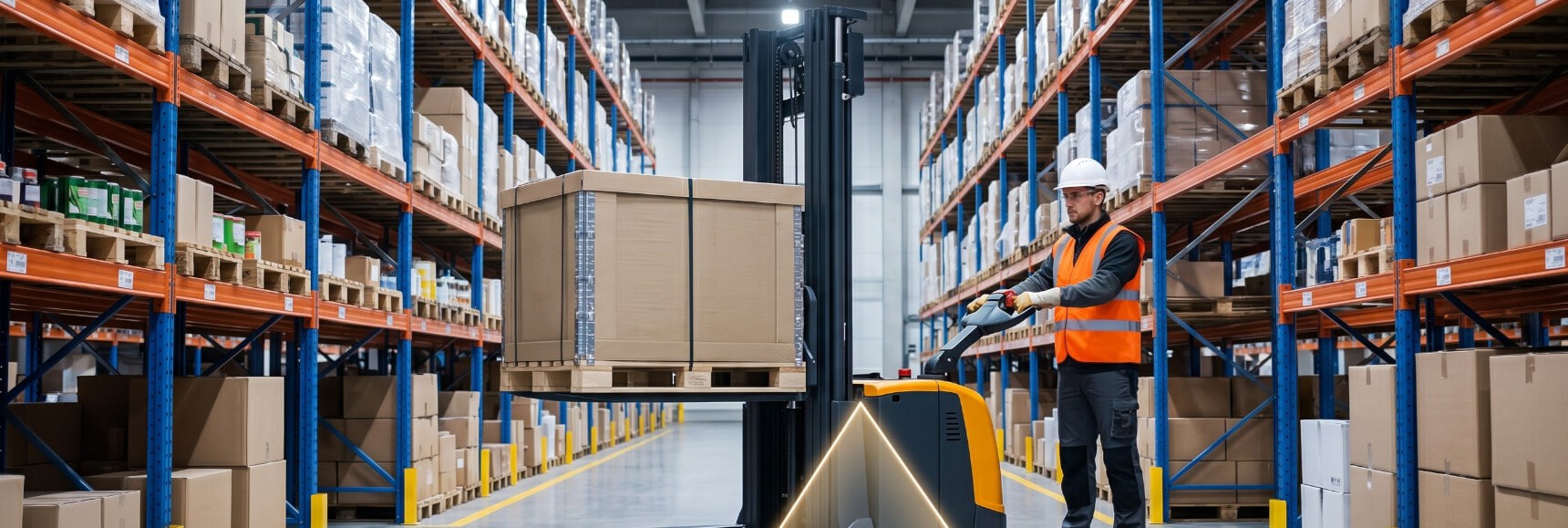
Every stacker operates on a specific center of gravity and the principle of the "stability triangle." As the load shifts toward the tips of the forks or as capacity limits are pushed, the center of gravity tends to move outside this triangle.
-
Load Center Distance: This is the distance from the center of gravity of the load to the vertical face of the forks. As this distance increases, the lifting capacity of the machine drops dramatically.
-
The Height Factor: As the load rises, the leverage effect increases. A load that is perfectly safe at a low altitude can turn into a dangerous moment that could topple the machine once it reaches 4–5 meters.
2. Impact of Technical Choices on Stability
Choosing the right machine solves 90% of stability issues at the procurement stage. The width of the chassis, the quality of the wheels, and the "flex" margin of the mast directly affect balance.
When determining the most suitable model for a business, criteria such as smooth mast operation and the alignment of chassis weight with the intended load should be prioritized over price alone. To understand how these technical details reflect on your operations, you can review our 10 technical criteria for choosing an electric stacker guide to make a more informed decision.
3. Stability Differences in Manual vs. Battery Models
The issue of balance also varies according to the technology of the machine used:
-
Manual Models: These are generally lighter, and balance is entirely under the physical control of the operator. The risk of loss of control is higher on uneven floors.
-
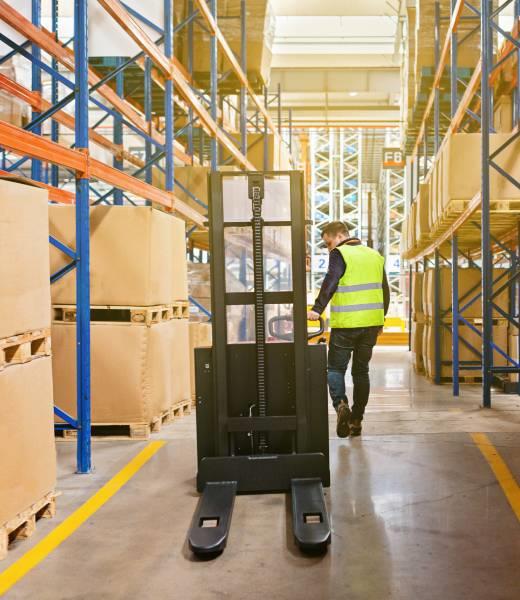
Battery-Powered Models: The heavy batteries located at the bottom of the machine keep the center of gravity close to the ground, providing natural stability. They are also often equipped with speed limiters and protection against sudden maneuvers.
To understand which technology is safer based on your business volume, our manual vs. battery stacker comparison for low-volume warehouses article can guide you.
4. Key Factors Threatening Stability
|
Factor |
Risk Scenario |
Solution |
|
Ground Condition |
Sloped or uneven floors disrupt balance instantly. |
Use wheels suitable for the floor and maintain low speeds. |
|
Loading Error |
Failure to center the load on the forks triggers tipping. |
Always secure the load to the center. |
|
Sudden Maneuvers |
Sharp turns while the load is at height cause shaking. |
Do not move the machine while the load is elevated. |
|
Worn Parts |
Loose chains or worn wheels reduce stability. |
Perform periodic maintenance and inspections. |
In conclusion; balance in a stacker is a negotiation with the laws of physics. Through correct system selection and trained operators, you can always emerge safely from this negotiation. Remember, it is not the fastest machine that finishes the job, but the most balanced one.