Battery Selection and Maintenance Guide for Battery Pallet Trucks and Stackers
The continuity of logistics operations depends on the energy efficiency of the equipment used. For a battery pallet truck or battery stacker, the battery is the heart of the system. Incorrect battery selection or insufficient maintenance practices shorten the machine's operating time, increase operational costs, and consume equipment life. Technical details that businesses should pay attention to in energy management are not limited to charging time.
Understanding the differences between battery technologies and implementing correct maintenance routines directly affects warehouse efficiency.
There are three main battery technologies used in industrial lifting equipment. Each technology appeals to different work intensities and budgets.
Lead-Acid (Wet) Batteries
The most traditional technology. It stores energy with lead plates and sulfuric acid solution inside the cells. It is an economic solution but requires high maintenance. Since it emits gas during charging, it requires special ventilated charging rooms.
Gel Batteries
Sealed system batteries where the electrolyte is in gel consistency. They do not emit gas, so they are suitable for food and pharmaceutical warehouses. They do not require maintenance (pure water replenishment). However, they are sensitive to deep discharge.
Lithium-Ion (Li-Ion) Batteries
The most efficient solution for modern warehousing. It charges fast, allows opportunity charging (intermediate charging), and requires no maintenance. Its lightweight structure increases maneuverability in battery pallet truck models. It offers the lowest total cost of ownership in the long run.
Battery Technologies Comparison Table
|
Feature |
Lead-Acid Battery |
Gel Battery |
Lithium-Ion Battery |
|
Maintenance Need |
High (Pure water refill) |
None (Maintenance-free) |
None (Maintenance-free) |
|
Charging Time |
8 - 10 Hours |
10 - 12 Hours |
1 - 2 Hours |
|
Charge Cycle (Life) |
1,200 - 1,500 |
700 - 1,000 |
3,000 - 4,000+ |
|
Opportunity Charging |
Not Suitable |
Not Suitable |
Very Suitable |
|
Energy Efficiency |
70% - 75% |
80% - 85% |
95%+ |
|
Gas Emission |
Yes (Ventilation req.) |
None |
None |
Technical limits must not be exceeded to protect battery life. The main reason for premature failure of a battery stacker battery is incorrect charging habits.
-
Discharge Limit (20% Rule): The machine should be put on charge before the battery capacity falls below 20%. Completely draining the battery (deep discharge) leaves permanent damage to the cells.
-
Full Charge Requirement (For Lead-Acid): When lead-acid batteries are put on charge, the process should reach 100% fullness without interruption. Interrupted charging processes lead to sulfation and reduce capacity.
-
Opportunity Charging (For Li-Ion): A battery pallet truck with a lithium battery can be charged during short breaks such as lunch breaks. This process does not harm battery life; on the contrary, it extends the daily working time.
Battery maintenance is not just filling energy. Physical checks minimize the risk of malfunction.
-
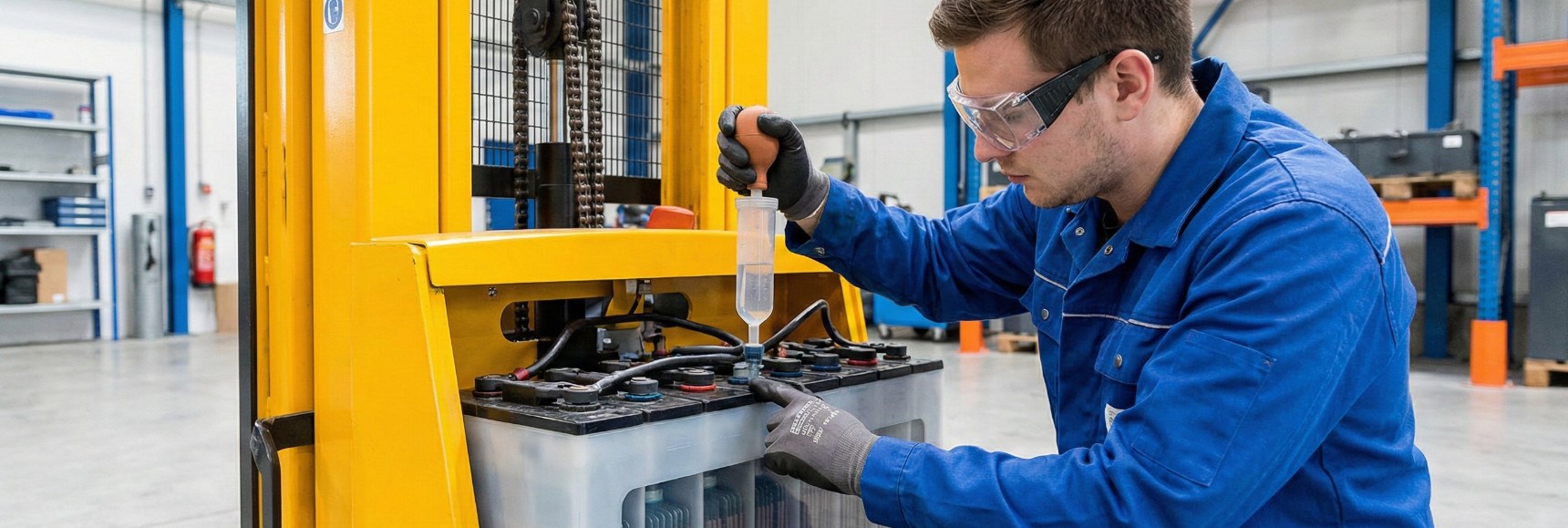
Pure Water Check: In lead-acid batteries, the liquid level on the plate should be checked weekly. If there is a decrease, only pure water should be added; adding acid burns the cells.
-
Terminal Cleaning: Oxidized terminals increase resistance and cause heating. Cleaning should be done with special sprays that prevent corrosion.
-
Winter Storage: Cold weather reduces battery capacity by 30%. Equipment not used in winter should be stored at room temperature and fully charged. A battery kept empty cracks by freezing in cold weather.
Choosing the right battery extends machine life while lowering operating expenses. Let's examine with a concrete example:
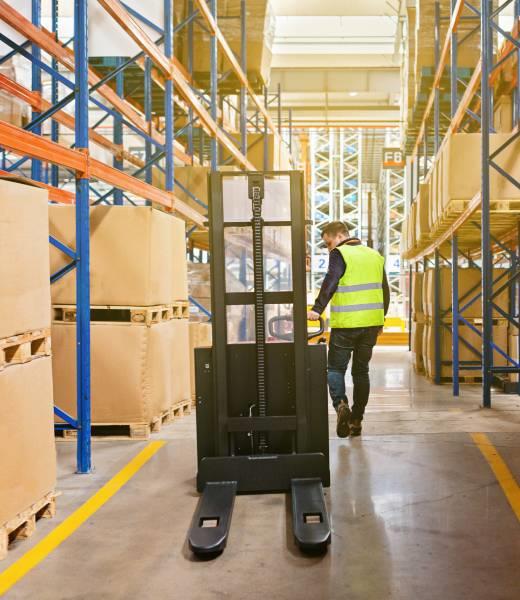
In a warehouse operating 12 hours a day, a battery stacker using a lead-acid battery needs a second spare battery due to charging time. The labor and time loss spent during spare battery replacement creates a serious cost on an annual basis. When the same work is done with a lithium-ion battery; a single battery saves the whole day with fast charging during short breaks. Spare battery cost, maintenance labor, and charging room expenses are eliminated. This investment pays for itself in an average of 18-24 months.